

Guard Tour System
A guard tour system digitizes patrol rounds and provides audit-proof documentation. With GPS live tracking, NFC checkpoints and man-down alarm, plan, monitor and document every patrol – book your appointment now.
Security, cleaning, and facility companies rely on LiteLog.





What is a guard tour system and how does it work?
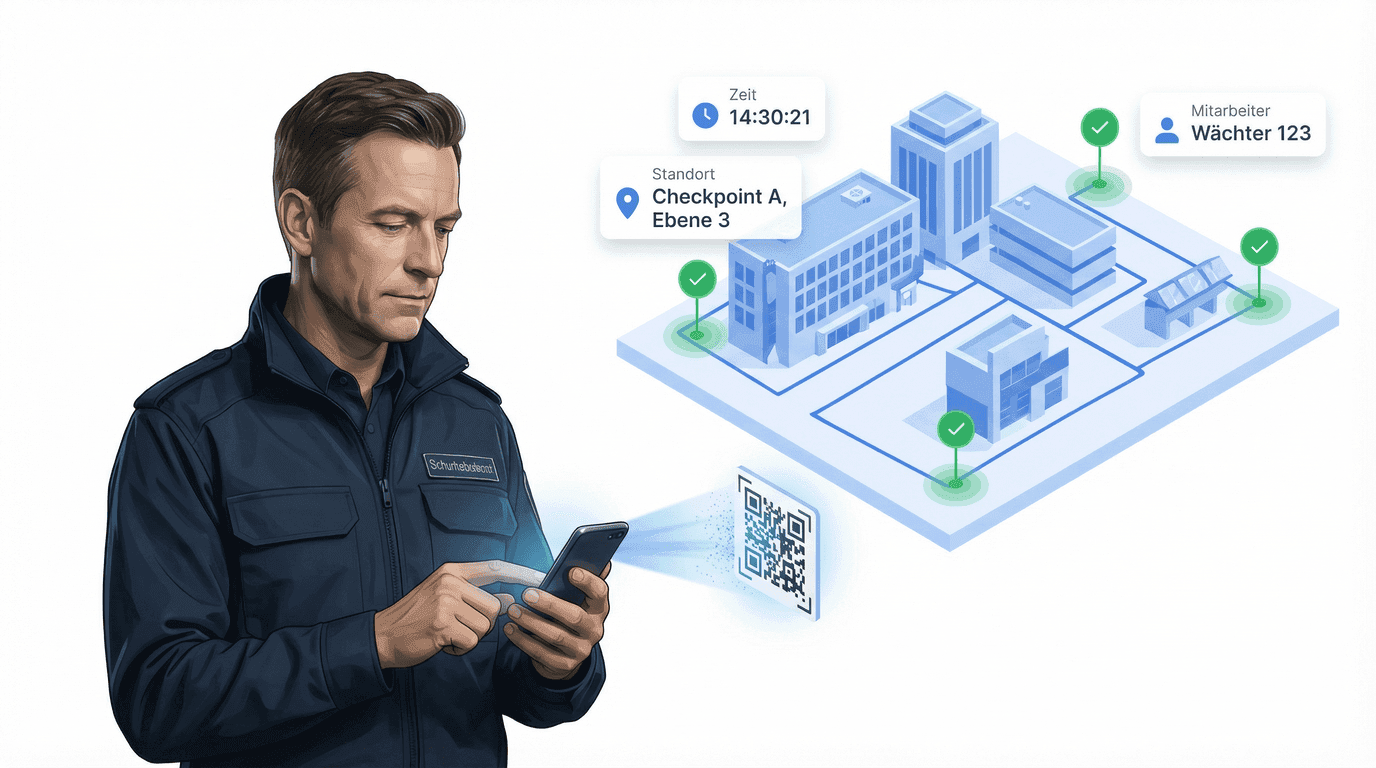
A guard tour system (GTS) digitally documents every patrol round performed by security staff. It replaces mechanical clock systems and paper logs with smartphone-based checkpoints using GPS, NFC, or QR codes. Every scan is automatically stored tamper-proof with time, location, and user.
- ✓Define checkpoints: NFC tags, QR codes, or GPS zones are placed at strategic points of the site.
- ✓Patrol via smartphone: Staff scan each checkpoint during the patrol using the app.
- ✓Live documentation: Time, location, person, and events are automatically logged in an audit-proof record.
What features should a good guard tour system have?
A good guard tour system covers more than just checkpoint scanning. Alongside patrol documentation, it must provide live oversight, alerts, incident reporting, and audit-proof evaluation — so operations leadership and clients both have solid evidence at all times.
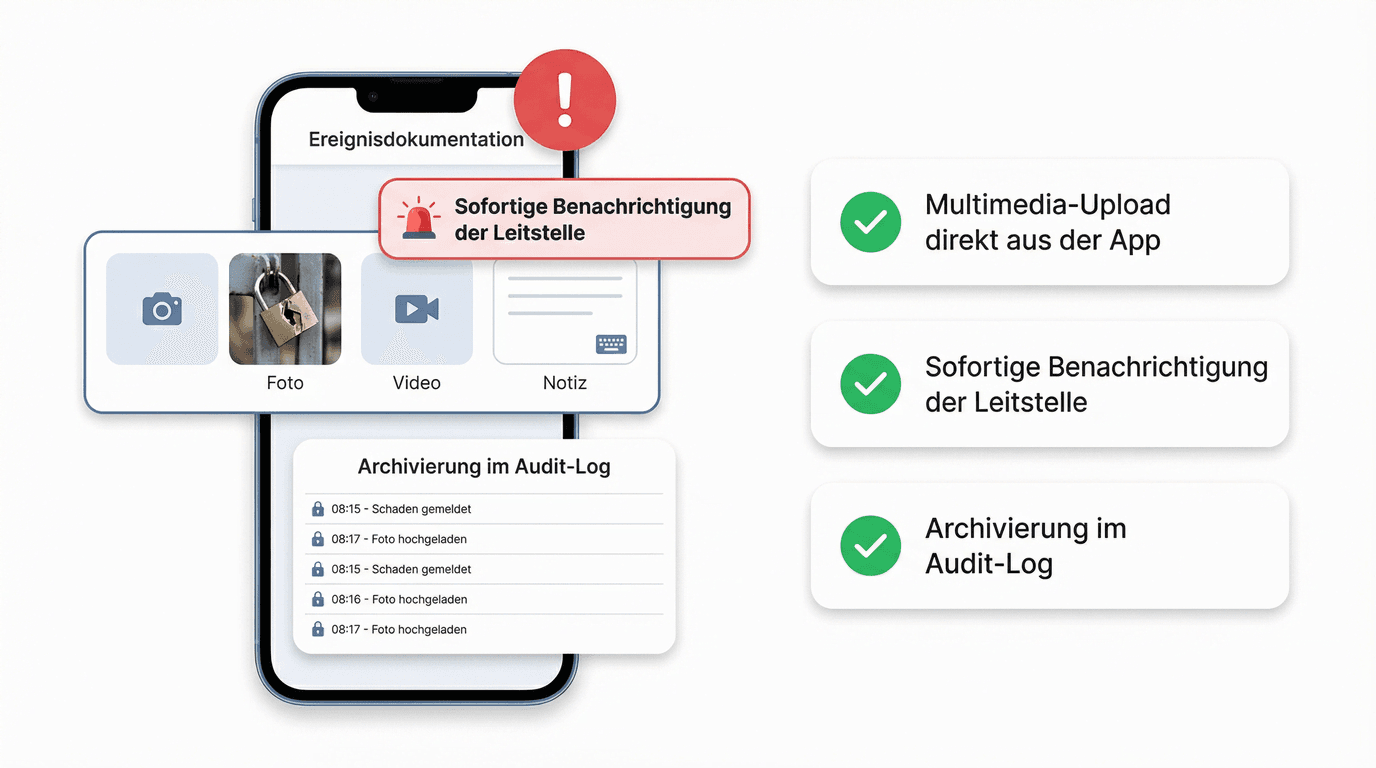
- ✓NFC, QR code, and GPS: Flexible checkpoint methods adapted to each site and industry.
- ✓Live tracking & target-vs-actual: Real-time overview of active patrols, automatic deviation alerts.
- ✓E-guard book with photo evidence: Events, photos, and notes are documented audit-proof in the patrol context.
How can I digitally document patrols in building security?
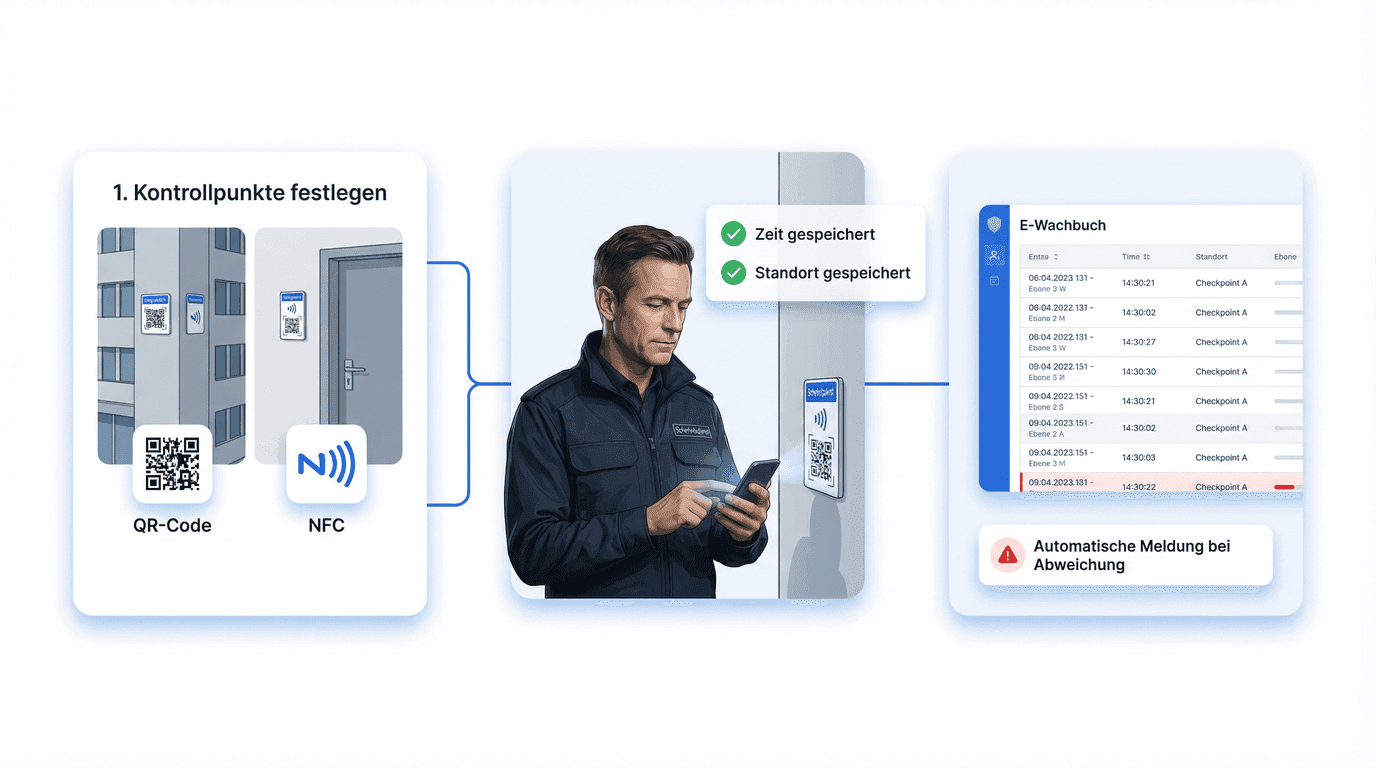
In building security, patrols must be provable end-to-end — for clients, insurers, and internal audits. Digital documentation replaces handwritten reports with automatically captured scans. It works in four steps:
- ✓1. Plan the patrol: Define checkpoints and sequence in the portal, optionally with time windows and recurrence.
- ✓2. Place checkpoints: NFC tags or QR codes on doors, rooms, or zones. Alternatively, define GPS zones.
- ✓3. Perform the patrol: Staff scan each checkpoint via smartphone. The app guides them step by step.
E-Guard Book – digital & automated
The e-guard book logs every patrol live and combines checkpoints, incidents and photos into a central record. Reports can be filtered by time period, site or incident type and sent automatically as PDF to clients or internal recipients. This gives clients regular audit-proof documentation in corporate design — without any manual effort from your team.
- ✓Real-time logging of photos & events
- ✓Filterable reports by time period, site & type
- ✓Automatic PDF reports in corporate design
Revier Service & Map-Based Verification
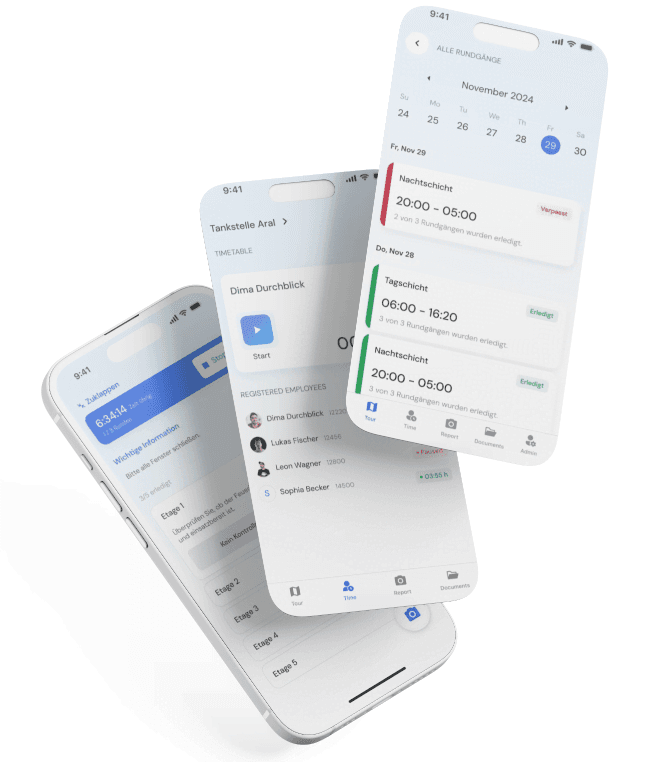
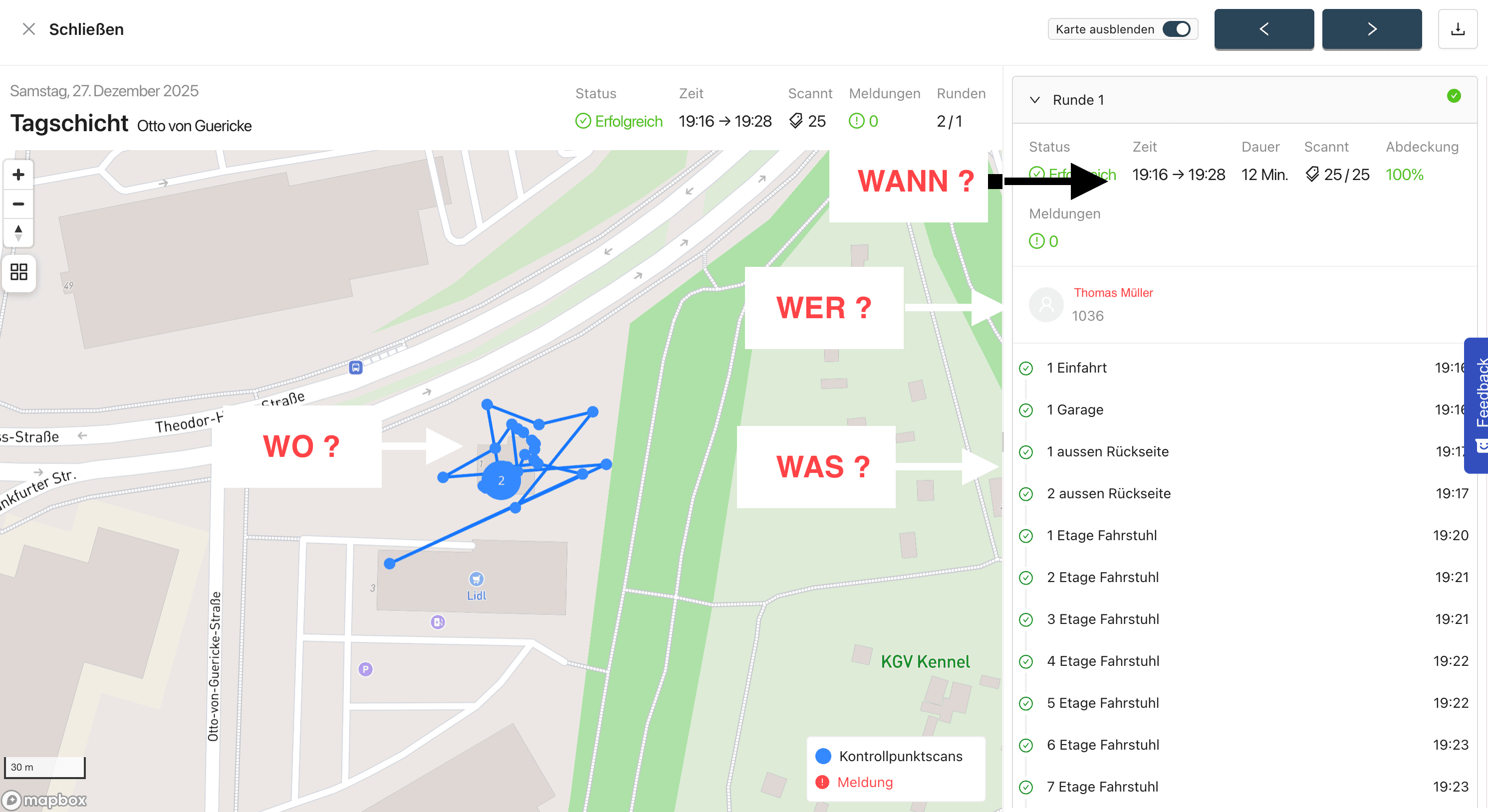
In mobile patrol and revier services, multiple locations are visited in a flexible order, often across large areas. The guard tour system records each checkpoint scan with time and GPS location and displays the results clearly on a map. Clients can see at a glance which sites were checked and when — eliminating follow-up questions and misunderstandings.
- ✓Mobile patrols across multiple locations
- ✓NFC or QR checkpoints in revier services
- ✓GPS verification of every scan time and location
How a guard tour system strengthens your business
More visibility. Less effort. Clear proof.
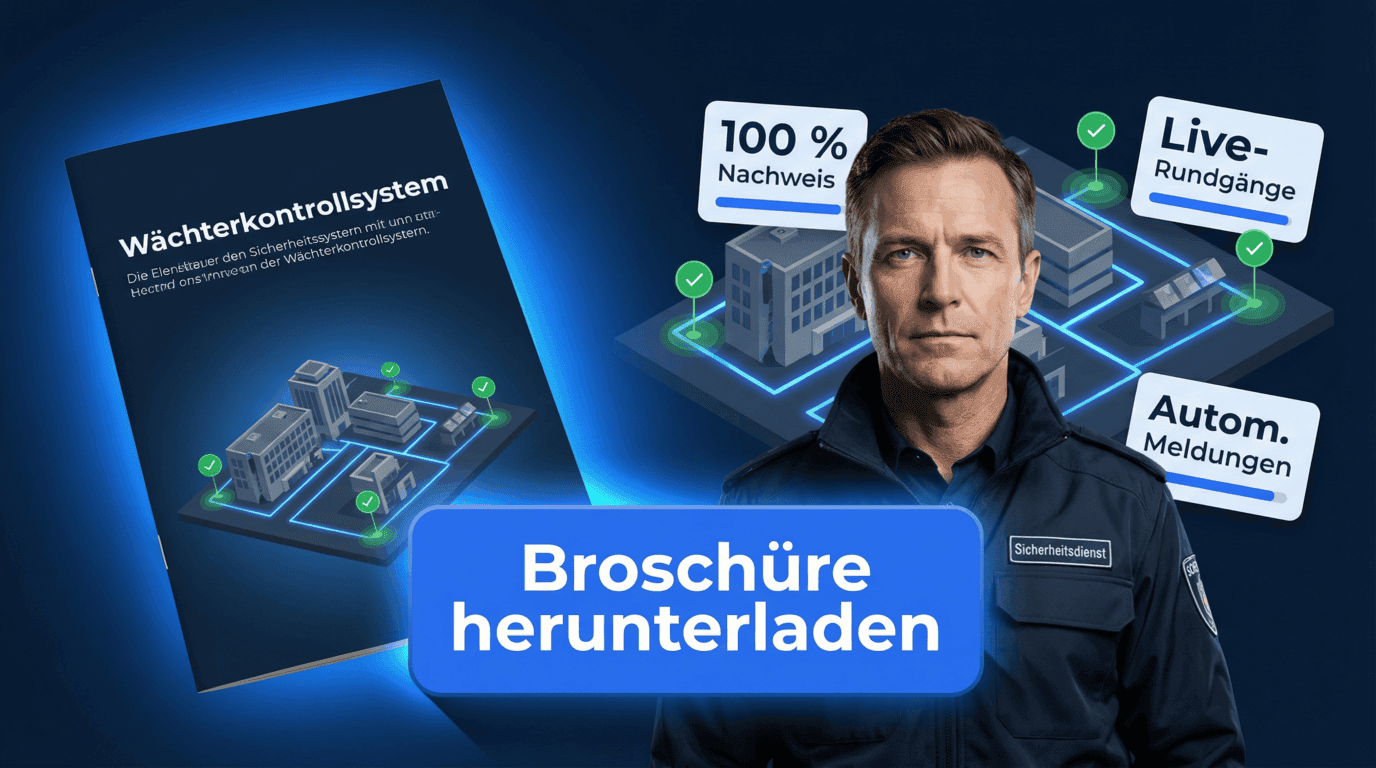
Download guard tour brochureKeep patrols in view
Respond immediately to deviations
Reduce manual admin effort
Build trust with clear proof
Popular Guard Tour System features
Rounds & Control Routes
Plan, execute and document rounds and control routes digitally.
Alarm Notifications
Automatic alerts for missed patrols, reports or shift check-ins.
Incident Documentation
Document incidents with text, photos and timestamps.
Customer Access, Roles & Permissions
Control exactly who can view or edit which data.
Time Tracking via QR Code
Many companies use simple time tracking systems. But time alone is not enough when attendance, location and reliability are decisive. LiteLog is more than time tracking—it is a location-based attendance and proof system.
Custom Reports & Exports
Assemble reports from building blocks yourself, sent automatically as PDF/A.
Our Standards
Secure, Flexible, GDPR Compliant

GDPR compliant
We comply with GDPR. Your data stays in Germany and we guarantee the highest security standards.
Servers in Germany
Your data is securely hosted on German servers, protected by strict German data protection laws.

Cross-platform
Backoffice works on any computer in the browser. We support iPhone and Android devices.
FAQ
Frequently asked questions about LiteLog
Which guard tour system vendors are available in Germany?
The German market offers a mix of classic vendors (with mechanical clocks and proprietary hardware) and modern cloud-based vendors like LiteLog that rely on smartphone apps with NFC and QR codes. Key selection criteria: GDPR compliance, hosting in Germany, German-speaking support, and industry experience in private security. For smaller service providers, cloud solutions without setup costs are usually more economical than proprietary hardware.
Are there guard tour systems with GPS tracking for security services?
Yes. LiteLog offers GPS verification for every checkpoint scan — without permanent live tracking of the guard (for privacy reasons). On scan, the GPS position is captured and matched against the expected location. This proves that the patrol took place at the correct site without continuously monitoring staff.
How do I install a guard tour system myself?
A modern guard tour system like LiteLog requires no classical installation. Sign up in the portal, place QR codes or NFC tags at the checkpoints, download the app from the store — done. Setup typically takes less than an hour, no IT technician and no server infrastructure required. Tutorials and video guides are available in the onboarding.
Which mobile apps support modern guard tour systems?
The LiteLog app runs on Android and iOS and is free in Google Play Store and Apple App Store. It supports NFC scans (on NFC-equipped Android devices), QR code scanning via the smartphone camera, and GPS verification. For offline situations, a full offline mode is available.
Which guard tour systems are well suited for small security companies?
For small security companies, cloud-based systems without setup costs are the best choice — no IT overhead, no servers, no hardware investment. LiteLog starts with a 14-day free trial, and billing is per site (not per employee). This makes it affordable for teams of 2–10 security staff.
How can I integrate a guard tour system into existing security processes?
Integration happens step by step: first, existing patrol plans are configured in the system, then checkpoints are placed at the known control points. Staff are briefed — usually a short demo is enough. LiteLog also offers APIs and export interfaces for shift planning, payroll, or client reporting.
What are best practices for security patrols?
Effective security patrols follow four principles: (1) Patrol order and timing should vary to avoid predictability. (2) Every checkpoint is documented with a timestamp and — for suspicious observations — with a photo. (3) Deviations from the plan (missed scans, delays) automatically trigger alarms. (4) Reports are archived audit-proof to prove correct execution if an incident occurs.
Which software is available for documenting patrol rounds?
Modern patrol documentation software combines patrol planning, checkpoint scanning, incident reporting, and automated reports in one platform. LiteLog covers all these functions: NFC/QR/GPS checkpoints, photo and event documentation, PDF reports in corporate design, and an e-guard book with filterable archiving. All data is hosted GDPR-compliant in Germany.
What is a guard tour system?
A guard tour system is a digital solution used to monitor and document security patrols. Guards scan predefined checkpoints, and the system records time, location and user automatically.
How does a guard tour system work?
Checkpoints are placed along a patrol route. During the patrol, guards scan these points using a smartphone or device. The system logs each scan and creates a complete patrol record.
What does GTS (guard tour system) stand for?
GTS is the common abbreviation for guard tour system — a digital solution for monitoring and documenting patrol rounds in private security. The term originates from the era of mechanical guard clocks and is used today for their digital successors. Modern GTS use smartphone apps instead of proprietary hardware. Abbreviation: GTS = Guard Tour System (also: patrol monitoring system, guard clock system). Purpose: Proof that checkpoints were verified at the planned time. Use cases: Asset protection, mobile patrol, plant security, event security. Components: Checkpoints (NFC/QR/GPS) + mobile app + reporting portal. German term: „WKS — Wächterkontrollsystem".
What is patrol tracking?
Patrol tracking is the process of digitally recording patrol rounds. It ensures that patrols are completed as planned and provides proof of presence at each checkpoint.
What is the difference between a guard tour system and a digital guard book?
The guard tour system captures patrol activity. The digital guard book is the resulting documentation that contains patrol logs, incidents, photos and timestamps.
Do I need special hardware for a guard tour system?
In most cases, a standard smartphone with NFC or GPS is sufficient. Rugged devices can be used for demanding environments. Learn more about hardware & equipment with LiteLog: /en/hardware-ausstattung.
Does a guard tour system work offline?
Yes. Patrol data can be recorded offline and is automatically synchronised once an internet connection is available.
Guard tour system comparison: digital vs. classic — what types exist?
Classic guard tour systems use mechanical clocks or data collectors. Evaluation happens with a delay at a PC, and photos or GPS data are missing. Modern guard tour systems like LiteLog use smartphone apps with NFC or QR checkpoints instead. Patrols are transmitted in real time, incidents are captured with photo and location. Switching saves hardware costs, reduces administrative effort and gives clients reliable proof of service immediately. Benefits of digital systems: no specialised hardware — existing smartphones are sufficient; real-time data instead of delayed evaluation at a PC; multimedia evidence with photo, GPS and timestamp; cloud-based and ready to go without installation effort.
Which use cases require a guard tour system?
Guard tour systems are used for security patrols, facility management, construction site monitoring, accommodations and industrial sites.
What are the benefits of a digital guard tour system compared to paper logs?
Digital guard tour systems prevent manipulation, reduce administrative effort and provide reliable proof of completed patrols.
Is the guard tour system GDPR compliant?
Yes. LiteLog hosts data in Germany, encrypts data transfers and offers role-based access controls to meet GDPR requirements.
Ready to experience LiteLog?
Book your appointment now without obligation!