Resident Meal Billing in Care Homes: QR Code Instead of Paper Lists
Meal billing in a care home is still one of the most manual processes in the whole building. Residents come to the dining room, a team member ticks a box on a paper list, and at month-end someone retypes the lists into Excel. Each step costs time and opens the door to mistakes. A single missed tick and the bill sent to the care fund or the family no longer matches what actually happened.
This article explains how meal billing can be handled without paper, how QR codes keep resident data protected under GDPR, and what records care-home management and inspectors get in return.
Why Paper-Based Meal Billing Fails
Manual lists fail under real-world conditions. Staff turnover is high, shifts change fast, and the dining room is busy. A single moment of distraction — and an attendance is missed. Double-counts happen too, especially when residents move between tables.
Three recurring issues in homes we speak with:
- Month-end retyping. Paper lists are typed into Excel, often by a single person under time pressure. Transcription errors are common.
- No audit trail. If an inspection asks how meal participation was recorded last Tuesday evening, the answer lives in a binder — somewhere.
- Data-protection worries. Lists with resident names are visible to visitors, cleaners and kitchen staff. That is not compatible with GDPR good practice.
How QR-Based Meal Billing Works
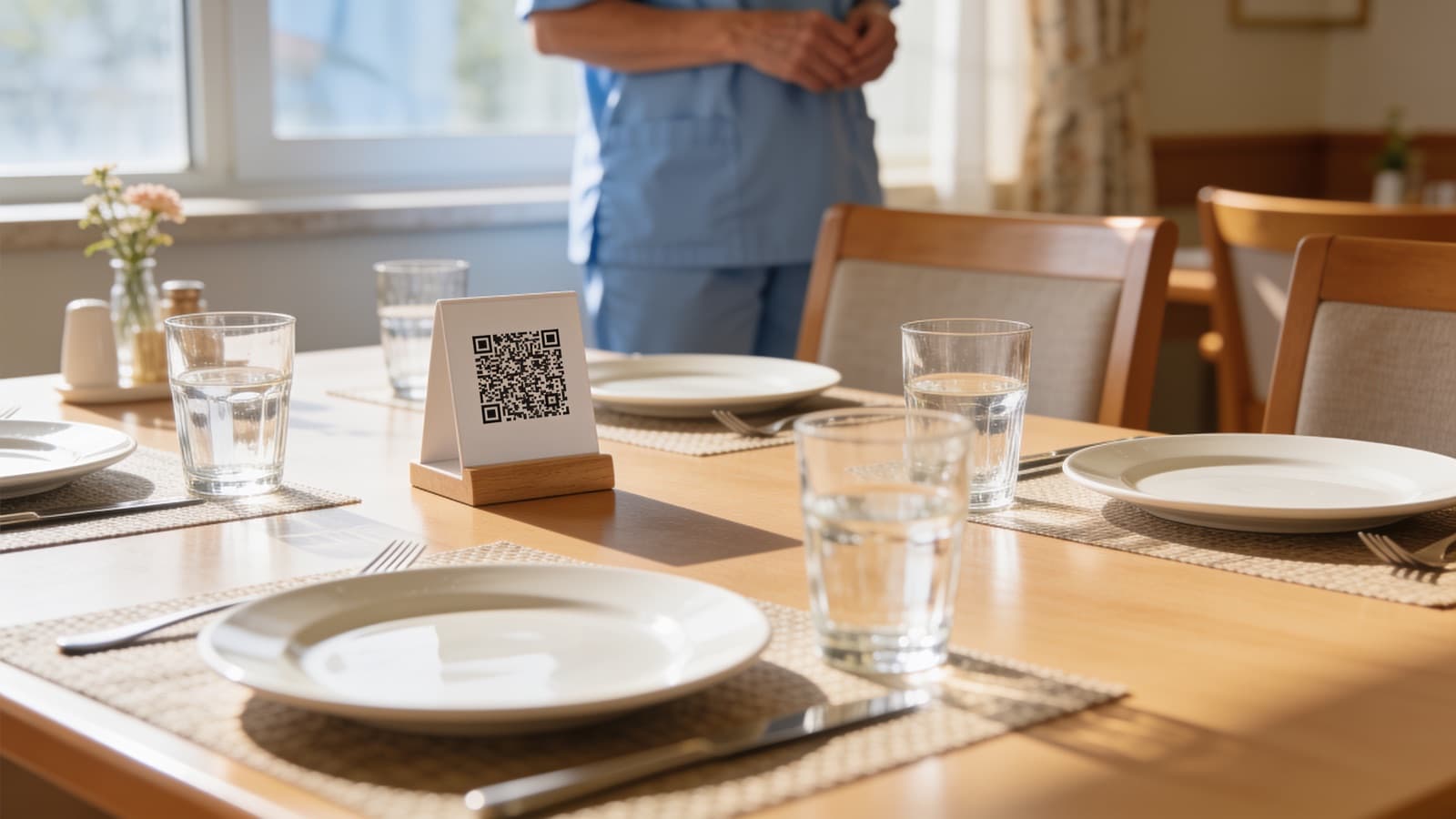
Each resident receives an anonymous ID that is printed as a QR code and placed at their usual seat. The code carries no plain name — only the ID.
At every meal, nursing or catering staff scan the code on the table. The app prompts for a confirmation. That confirmation becomes the attendance record.
LiteLog knows the meal schedule — breakfast 07:00 to 10:00, lunch 11:00 to 14:00, dinner 18:00 to 20:00 — and assigns each scan to the active window automatically. The staff member does not choose the meal. The scan carries the right context by default.
GDPR: Why No Plain Name on the Code Matters
Plain names on physical objects in public-facing areas are a problem. A code that reads "Resident: Anna M., Room 214" is visible to any visitor who walks past the dining room. Under GDPR, that counts as avoidable exposure of personal data.
An anonymous QR code contains only an identifier. Without access to the LiteLog system, the ID is meaningless. Even if a visitor photographs the code, no personal data is revealed. Mapping to the actual resident happens inside the protected system, only for authorised staff.
The LiteLog platform runs on servers in Germany, transmits data encrypted and enforces role-based access. A data processing agreement (DPA) under GDPR is available by default — ready for the data-protection officer to review.
Evidence for Accounting and Inspection
What managers and inspectors actually want is not the raw scan. They want a report they can trust. LiteLog produces:
- Per-resident, per-period exports — every meal attendance across days and weeks.
- Per-meal summaries — how many residents attended breakfast on a given day, with deviations flagged.
- Audit-proof chain of custody — every entry carries a timestamp and staff ID. Corrections are logged as separate events; nothing is silently overwritten.
That is the difference between a paper list and a care-documentation system. The list tells you what somebody wrote down. The system tells you what happened, when and by whom.
Rolling Out in Practice
The typical path we recommend for care homes:
- Pilot one ward. Print QR codes, place them at the dining tables, train the team. Run for two to four weeks.
- Review reports with management. Does the month-end export match expectations? Where are deviations coming from — real or procedural?
- Roll out to the next ward. Add rooms, add rounds, add more staff roles as needed.
Care homes that already use LiteLog for room-by-room rounds and care documentation can add meal billing on top of the same system — no second app, no duplicate accounts.
Conclusion
Resident meal billing does not have to be a paper process. QR codes, anonymous IDs and time-window attendance remove the retyping, remove the exposure of names and produce an audit-proof record that holds up against care-fund reviews and inspections. Care homes that take this step protect residents, relieve staff and get paid for the meals they actually serve.