96%
Trusted by companies

Guard tour software digitizes patrol rounds and provides audit-proof documentation — no proprietary hardware, just the smartphones your team already carries. With GPS-verified scans, NFC checkpoints and man-down alarm, plan, monitor and document every patrol – GDPR-compliant, servers in Germany, from €39/month.
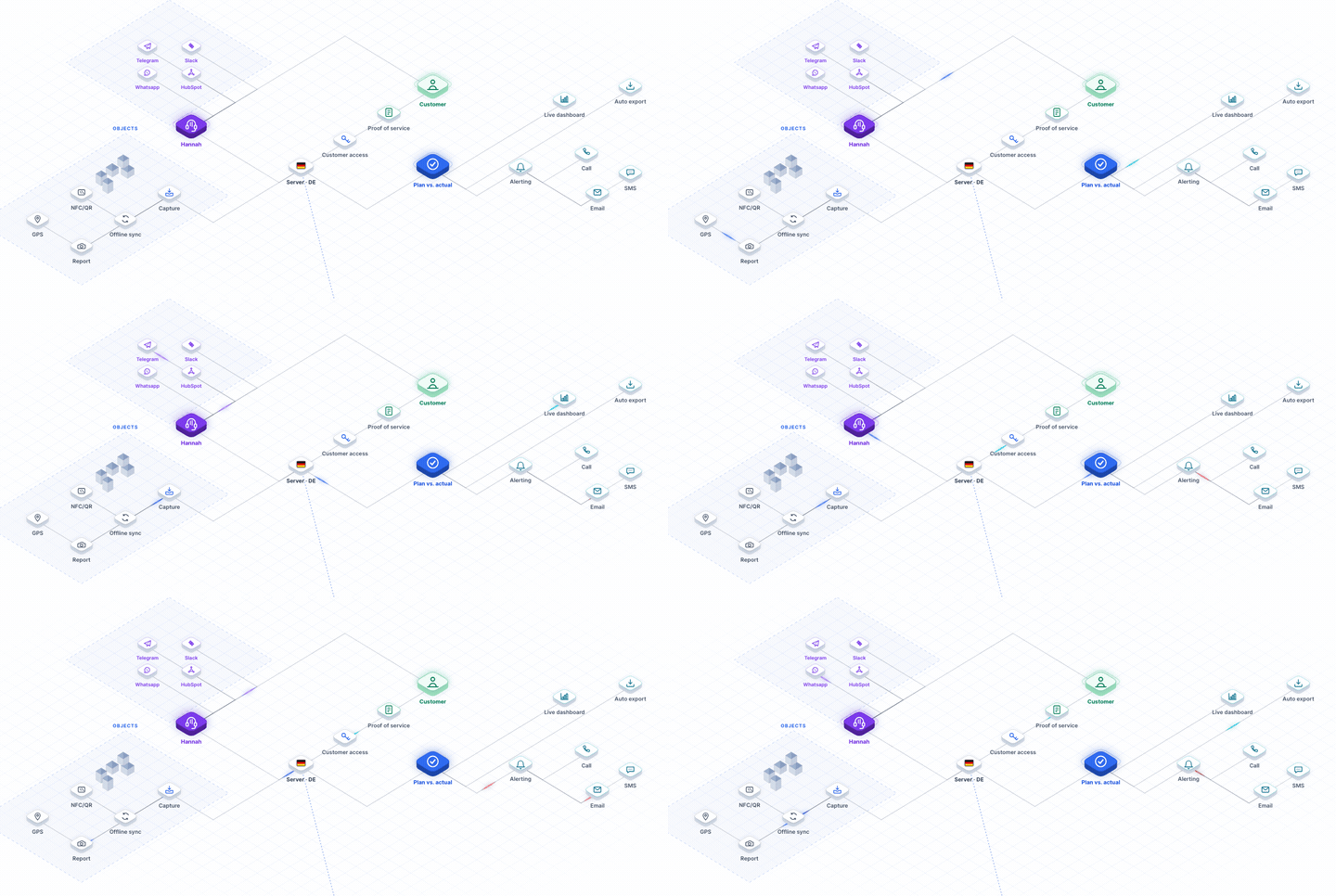
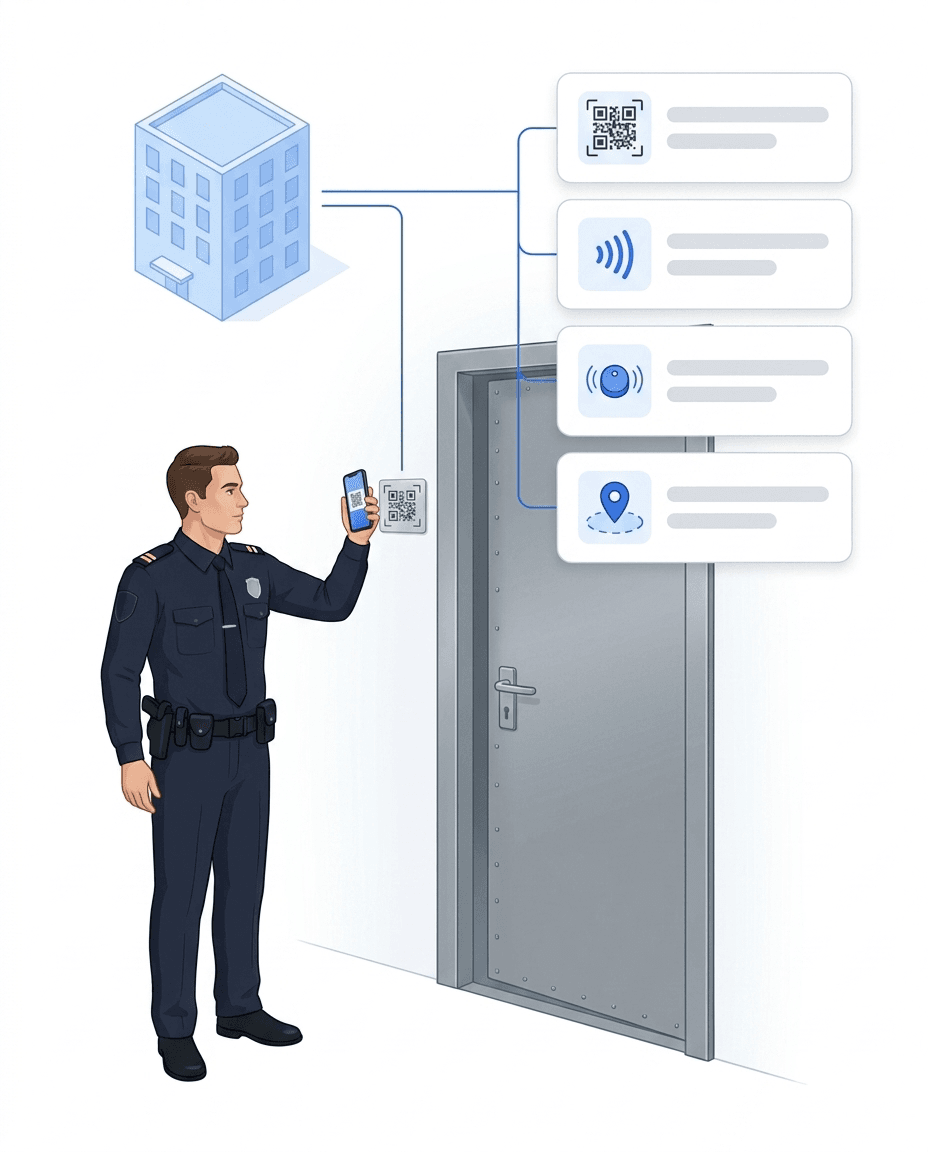
A guard tour system (GTS) digitally documents every patrol round performed by security staff. It replaces mechanical clock systems and paper logs with smartphone-based checkpoints using NFC, QR codes, or Bluetooth beacons. Every scan is automatically stored tamper-proof with time, GPS-verified location, and user.
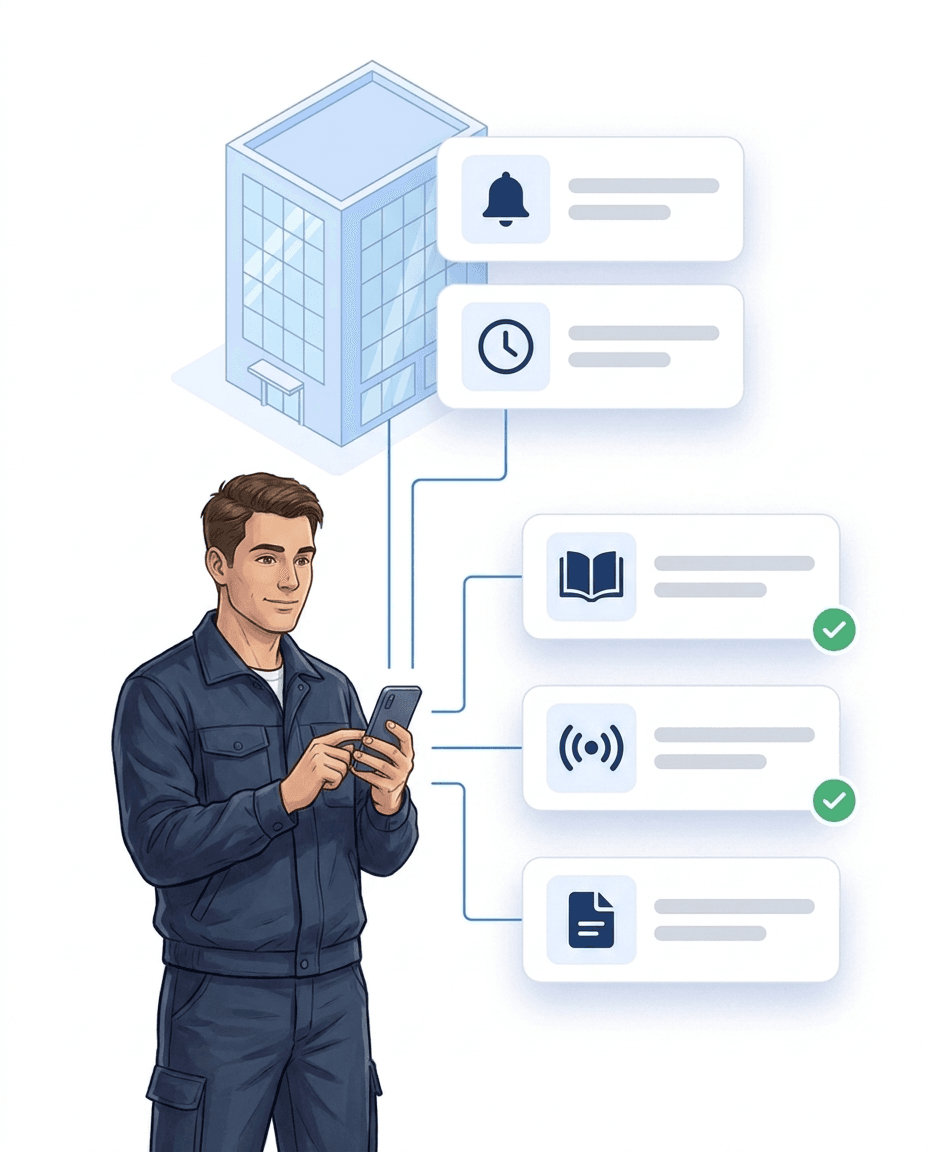
Good guard tour software covers more than just checkpoint scanning. Alongside patrol documentation, it must provide live oversight, alerts, incident reporting, and audit-proof evaluation — so operations leadership and clients both have solid evidence at all times.
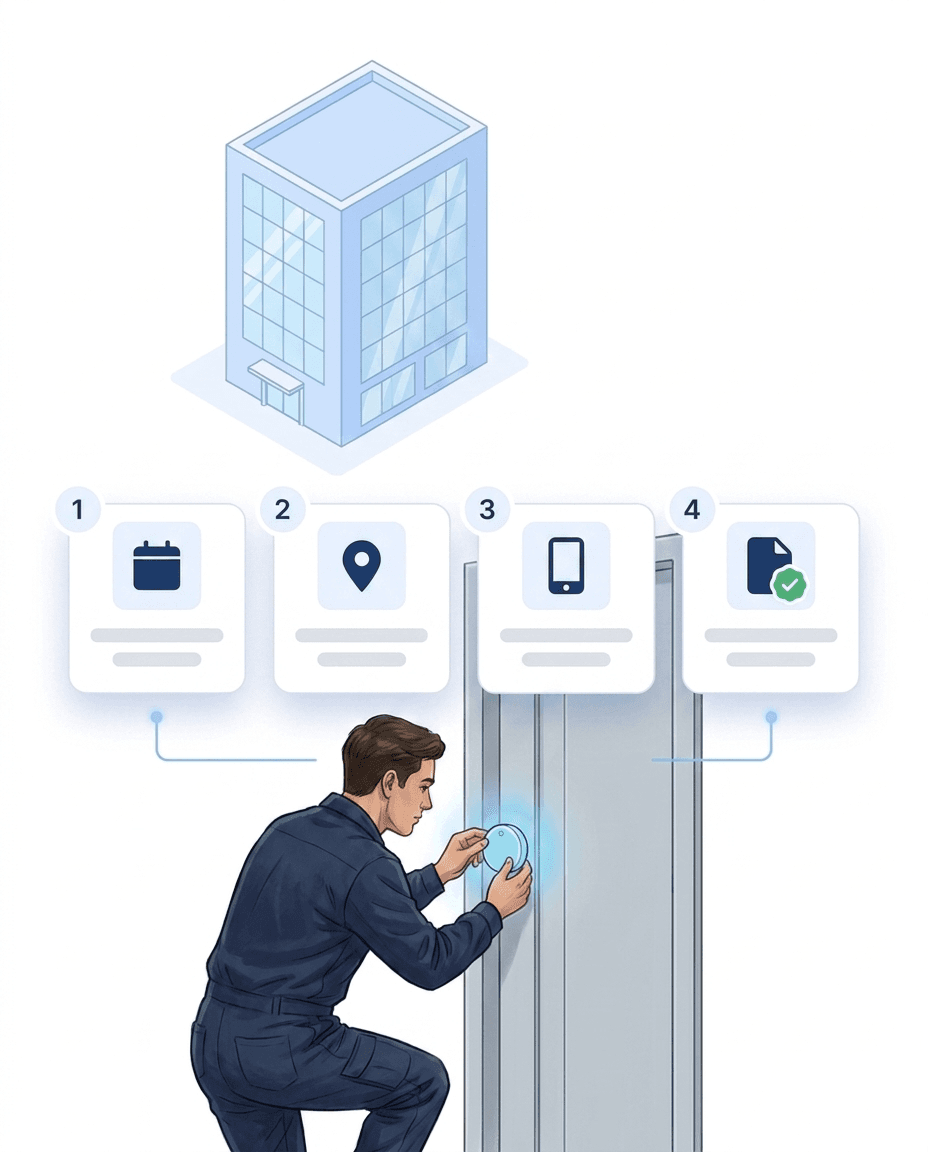
In building security, patrols must be provable end-to-end — for clients, insurers, and internal audits. Digital documentation replaces handwritten reports with automatically captured scans. It works in four steps:
Every patrol, incident and photo lands in the e-guard book automatically – retained in line with legal requirements and available to your client as a PDF at any time. Everything else lives on the dedicated guard book page.
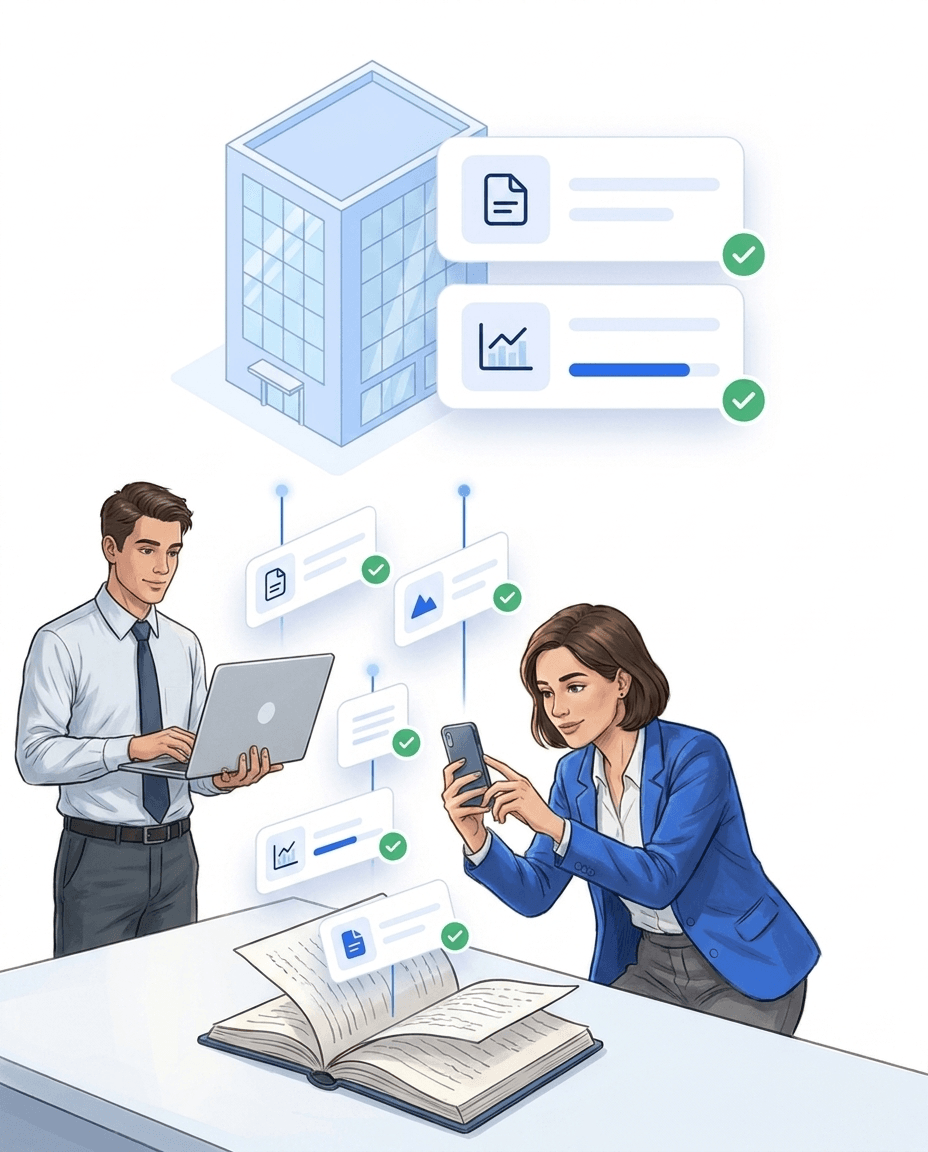
You plan the patrol with a time window. If a checkpoint is missed, LiteLog immediately alerts the right person and escalates via SMS or phone call if needed. At the end, the finished record goes to your client as a PDF – without anyone having to compile it.
More than 10 years experience in this industry
Digital guard control and time tracking for 20+ nationwide sites
Read the customer story →Austrian security provider: from login to the first documented shift in under a day – guard tour control and time tracking, audit-proof and without paper logbooks.
Clock in, break, clock out — one QR scan at the site is enough. Unlike plain time tracking, LiteLog also documents where the work happened: every stamp carries time, location and user, and becomes solid ground for payroll and client invoicing.
Learn more aboutWho works when at which site? Plan shifts on the planning board via drag-and-drop – with target vs. actual status lights per site and contract, cover suggestions and integrated leave management.
Learn more aboutDid the night shift really check every floor? Patrols built from NFC or QR checkpoints guide your staff step by step through the site — every scan is documented audit-proof, and if a patrol is missed, the alarm system triggers automatically.
Learn more aboutNight shift not started, patrol skipped, check-in missing? LiteLog doesn't wait for the monthly report — it alerts immediately, via push, email, SMS or phone call, optionally as a multi-level escalation chain.
Learn more aboutYou don't adapt to the software: LiteLog adapts to your processes. With the automation you freely combine 49 triggers and 10 actions into if-then rules — in the graphical editor without programming, and on request the AI creates the rule from a single sentence.
Learn more aboutForced door, water damage, shift handover: your employee takes a photo or records a voice memo — the AI categorizes the report automatically, and serious cases escalate via workflow straight to the site manager.
Learn more aboutOur Standards

We comply with GDPR. Your data stays in Germany and we guarantee the highest security standards.

Your data is securely hosted on German servers, protected by strict German data protection laws.

Backoffice works on any computer in the browser. We support iPhone and Android devices.
FAQ
The German market offers a mix of classic vendors (with mechanical clocks and proprietary hardware) and modern cloud-based vendors like LiteLog that rely on smartphone apps with NFC and QR codes. Key selection criteria: GDPR compliance, hosting in Germany, German-speaking support, and industry experience in private security. For smaller service providers, cloud solutions without setup costs are usually more economical than proprietary hardware.
Yes. LiteLog offers GPS verification for every checkpoint scan — without permanent live tracking of the guard (for privacy reasons). On scan, the GPS position is captured and matched against the expected location. This proves that the patrol took place at the correct site without continuously monitoring staff.
A modern guard tour system like LiteLog requires no classical installation. Sign up in the portal, place QR codes or NFC tags at the checkpoints, download the app from the store — done. Setup typically takes less than an hour, no IT technician and no server infrastructure required. Tutorials and video guides are available in the onboarding.
The LiteLog app runs on Android and iOS and is free in Google Play Store and Apple App Store. It supports NFC scans (on NFC-equipped Android devices), QR code scanning via the smartphone camera, and GPS verification. For offline situations, a full offline mode is available.
For small security companies, cloud-based systems without setup costs are the best choice — no IT overhead, no servers, no hardware investment. LiteLog starts with a 14-day free trial, and billing is a transparent monthly licence with no upfront investment. This makes it affordable for teams of 2–10 security staff.
Integration happens step by step: first, existing patrol plans are configured in the system, then checkpoints are placed at the known control points. Staff are briefed — usually a short demo is enough. LiteLog also offers APIs and export interfaces for shift planning, payroll, or client reporting.
Effective security patrols follow four principles: (1) Patrol order and timing should vary to avoid predictability. (2) Every checkpoint is documented with a timestamp and — for suspicious observations — with a photo. (3) Deviations from the plan (missed scans, delays) automatically trigger alarms. (4) Reports are archived audit-proof to prove correct execution if an incident occurs.
Modern patrol documentation software combines patrol planning, checkpoint scanning, incident reporting, and automated reports in one platform. LiteLog covers all these functions: NFC/QR/beacon checkpoints with GPS verification, photo and event documentation, PDF reports in corporate design, and an e-guard book with filterable archiving. All data is hosted GDPR-compliant in Germany.
Classic guard tour systems carry high upfront costs for clocks or data collectors — plus maintenance, replacement units and PC software. LiteLog instead bills as a transparent monthly licence, with no proprietary hardware and no setup costs. You start with a 14-day free trial and see the full feature set before you decide. For the full hardware-vs-app cost comparison, see our guard tour system cost guide.
A guard tour system is a digital solution used to monitor and document security patrols. Guards scan predefined checkpoints, and the system records time, location and user automatically.
Checkpoints are placed along a patrol route. During the patrol, guards scan these points using a smartphone or device. The system logs each scan and creates a complete patrol record.
GTS is the common abbreviation for guard tour system — a digital solution for monitoring and documenting patrol rounds in private security. The term originates from the era of mechanical guard clocks and is used today for their digital successors. Modern GTS use smartphone apps instead of proprietary hardware. Abbreviation: GTS = Guard Tour System (also: patrol monitoring system, guard clock system). Purpose: Proof that checkpoints were verified at the planned time. Use cases: Asset protection, mobile patrol, plant security, event security. Components: Checkpoints (NFC/QR/beacon) with GPS verification + mobile app + reporting portal. German term: „WKS — Wächterkontrollsystem".
Patrol tracking is the process of digitally recording patrol rounds. It ensures that patrols are completed as planned and provides proof of presence at each checkpoint.
The guard tour system captures patrol activity. The digital guard book is the resulting documentation that contains patrol logs, incidents, photos and timestamps. In LiteLog both parts are one system: checkpoint scans and guard book entries come together in the same interface.
In most cases, a standard smartphone with NFC or GPS is sufficient. Rugged devices can be used for demanding environments. GPS checkpoints need no hardware at the point at all – a configured radius is enough, and the app books automatically during a running patrol. Learn more about hardware & equipment with LiteLog: /en/hardware-ausstattung.
Yes. Patrol data can be recorded offline and is automatically synchronised once an internet connection is available.
Classic guard tour systems use mechanical clocks or data collectors. Evaluation happens with a delay at a PC, and photos or GPS data are missing. Modern guard tour systems like LiteLog use smartphone apps with NFC or QR checkpoints instead. Patrols are transmitted in real time, incidents are captured with photo and location. Switching saves hardware costs, reduces administrative effort and gives clients reliable proof of service immediately. Benefits of digital systems: no specialised hardware — existing smartphones are sufficient; real-time data instead of delayed evaluation at a PC; multimedia evidence with photo, GPS and timestamp; cloud-based and ready to go without installation effort.
Guard tour systems are used for security patrols, facility management, construction site monitoring, accommodations and industrial sites.
Digital guard tour systems prevent manipulation, reduce administrative effort and provide reliable proof of completed patrols.
Yes. LiteLog hosts data in Germany, encrypts data transfers and offers role-based access controls to meet GDPR requirements.
Yes. LiteLog documents checkpoints at doors and entrances via NFC or QR and records staff working time at the same time. Both data sets come together in one system. A single report shows who was on site when and which points were checked. No separate programs and no duplicate entry.
LiteLog specialises in patrol documentation and attendance. You connect existing access control or video systems via export interfaces and API. Incidents from the guard book can then be combined with camera or access events. Deeper hardware integration is reviewed case by case.
LiteLog captures the GPS position only at the moment of the checkpoint scan – there is no live tracking and no movement profile across the shift. What is documented is the agreed service at the property, not the behaviour of individuals; every guard sees their own times and patrols in the app, and roles control who can access which data. For co-determination, the works council information sheet (PDF, German) and the data processing agreement (PDF) are available for download – as a basis for your works agreement.
Alarms and escalations reach your control room directly as multi-stage chains via push, email, SMS or automated phone call – including wait times, re-checks and delivery logs. A standardised connection via alarm protocols such as VdS 2465 or SIA DC-09 is not part of the standard scope; connections to existing control room technology are assessed case by case via API and export interfaces. Availability and SLA details are on our data security page.
You define the mandatory checkpoints and a time window per patrol. If a point is not scanned or scanned too late, the system detects the deviation automatically. Management is notified immediately via app, email or SMS. A skipped checkpoint stands out right away, not only afterwards.
Via the optional Supplies & Equipment module. Keys and radios are kept as serialized items with a serial number, NFC chip or QR label; issue and the shift handover from person to person run by scan in the app — with an on-screen signature and a PDF receipt, offline too. Returns and losses with a reason are booked, so it is always clear who holds which device.
Yes. You draw the area as a restricted zone on the site map. When a checked-in guard enters the zone, the app warns immediately with the text you defined. Optionally an event is created when someone stays there longer than the configured time. Both can be used as triggers in the automation rules, for example to notify the control room. Only these events are stored, no movement profiles.
End manual lists – LiteLog digitises attendance, patrols and visitor management.
100% GDPR compliant – hosted in Germany 🇩🇪