Time Tracking Obligation for Employers — What Applies in 2026?
Since the landmark ruling by Germany's Federal Labour Court (BAG) on 13 September 2022, time tracking is mandatory for all employers. The obligation is clear, but many companies still lack a compliant system. This article explains the legal basis, what must be recorded, which penalties apply, and how to fulfill the requirement efficiently.
The Legal Basis: BAG Ruling and EU Working Time Directive
The BAG ruling (case 1 ABR 22/21) confirmed what the European Court of Justice had already established in 2019: employers must record working hours systematically. The court based its decision on Section 3 (2) No. 1 of the German Occupational Health and Safety Act (ArbSchG), interpreted in light of the EU Working Time Directive.
The ruling does not define a specific method. Employers may choose the system — but the system must exist. Failing to record working hours is a legal violation, regardless of company size.
Who Is Affected?
All employers in Germany. The obligation applies regardless of industry, company size, or employment type. Full-time, part-time, and temporary workers are included. There is no small-business exception.
Managers with significant autonomous scheduling authority may be excluded in narrow cases. For the vast majority of employees, the obligation applies without limitation.
What Must Be Recorded?
The law requires documentation of:
- Start of daily working time
- End of daily working time
- Break times — duration and timing
- Overtime — hours exceeding the contractual or statutory limit
- Duration of total daily working time
The records must be complete, traceable, and retained for at least two years.
What Penalties Apply?
Violations of the German Working Hours Act (ArbZG) carry fines of up to 30,000 euros per individual case. Repeated or systematic non-compliance can lead to higher penalties and regulatory orders.
Beyond fines, missing records create practical risks. Without documentation, employers cannot prove compliance with maximum working hours or rest periods. In disputes over overtime, the burden of proof shifts to the employer. Employees can claim back-pay for unrecorded hours — a financial risk that often exceeds any fine.
Paper, Excel, or App — What Meets the Requirement?
The law does not prescribe a specific format. In theory, paper timesheets or Excel lists are permitted. In practice, they create problems:
- Paper is easy to lose, hard to evaluate, and not audit-proof.
- Excel is easy to manipulate. A changed cell leaves no trace.
- Apps record times automatically, with timestamps, location data, and user attribution. Changes are logged. Exports are audit-proof.
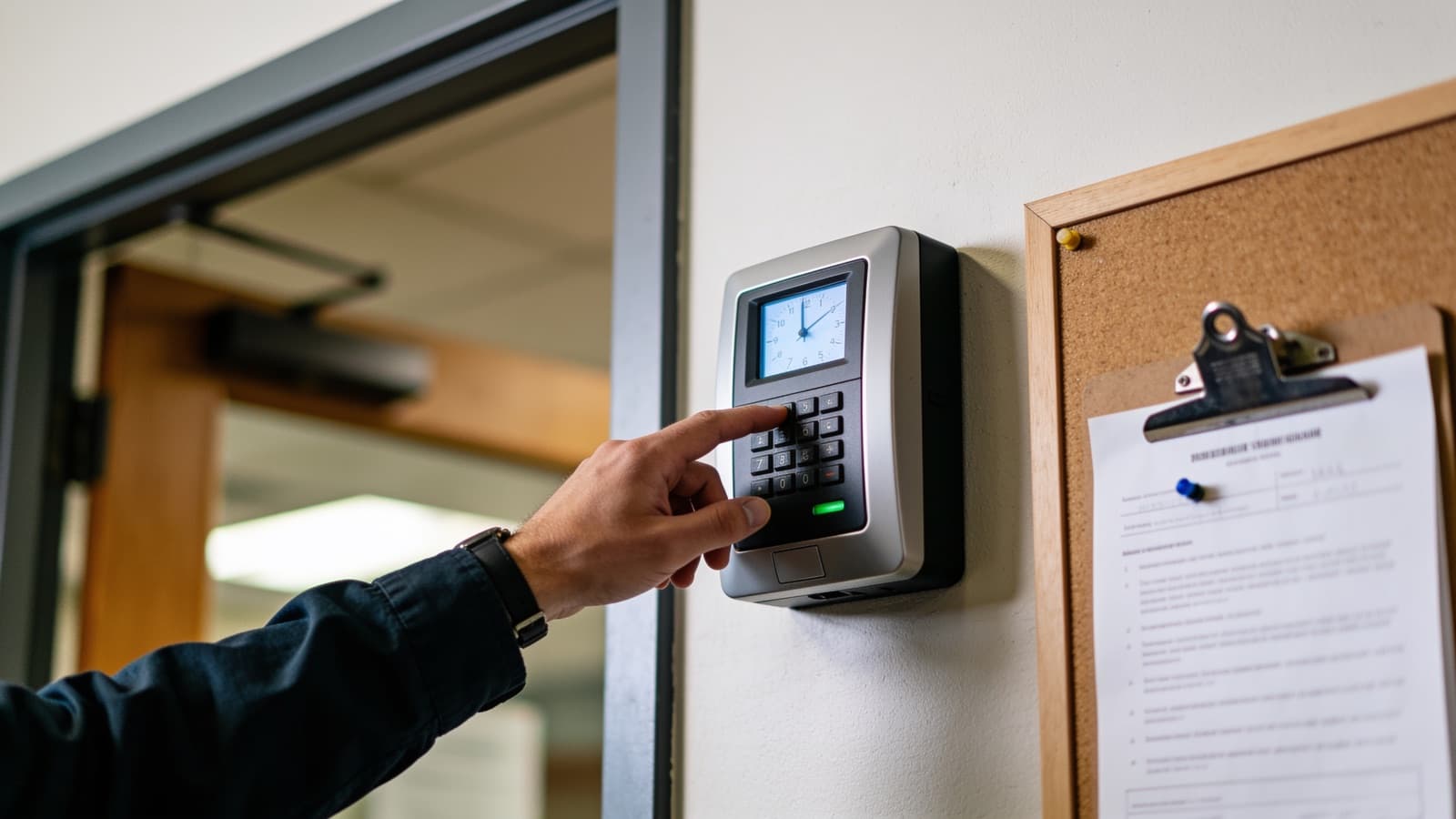
For companies with distributed teams or shift work, a digital solution is the only practical choice. An attendance tracking system ensures that all records are complete and verifiable.
How LiteLog Fulfills the Time Tracking Obligation
LiteLog provides a complete digital time clock that meets all legal requirements:
- Start, end, breaks, overtime — recorded automatically per shift.
- NFC, QR, and GPS — employees clock in at the workplace, verified by location.
- Audit-proof records — every entry includes timestamp, user, and device. Changes are logged.
- GDPR-compliant — hosted in Germany, encrypted, role-based access.
- Automated reports — export as PDF or Excel, ready for audits and payroll.
- Offline mode — works in basements, garages, and areas with poor connectivity.
- No special hardware — runs on any standard smartphone.
LiteLog is ready to use in minutes. No installation on-site, no training sessions lasting hours.
Conclusion
The time tracking obligation applies to every employer in Germany — without exception. The legal basis is clear since the BAG ruling of 2022. What remains is the question of implementation. Paper and Excel create risks. A digital time tracking app delivers compliance, transparency, and efficiency in one system. LiteLog fulfills every requirement from a single smartphone.