
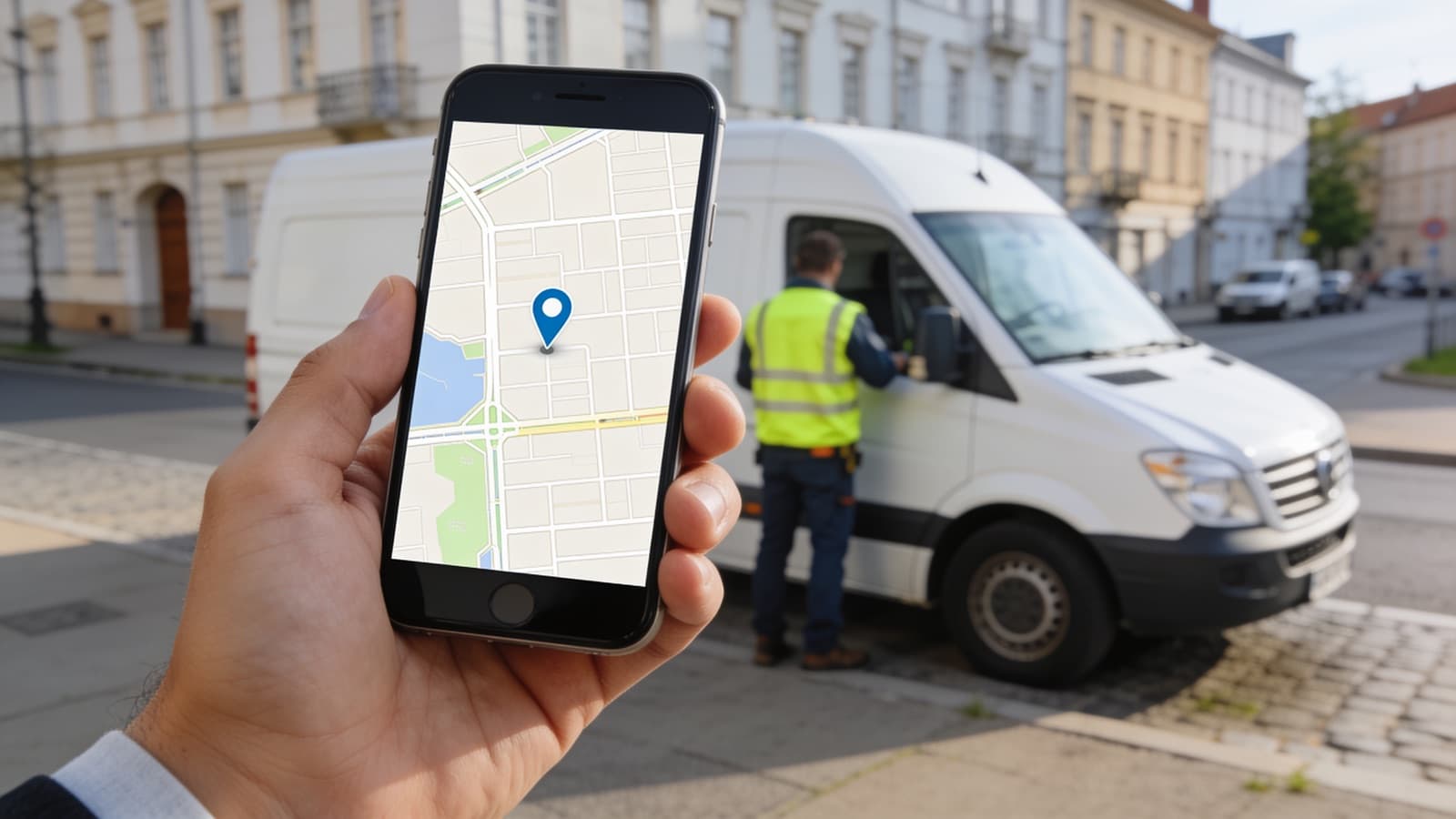
GPS Time Tracking: What Employee Monitoring Is Legally Allowed
GPS time tracking records where employees clock in and out. For field service, security patrols, and cleaning teams, this provides reliable proof of presence. But where is the legal boundary between legitimate time tracking and unlawful surveillance?
What Is GPS Time Tracking?
GPS time tracking records the employee's location at the moment of clocking in or out. The position is captured once and stored together with the timestamp. This creates a verifiable proof of presence — without recording movement between check-ins.
Typical use cases: security patrols across multiple sites, cleaning teams servicing different buildings, and field technicians visiting customer locations. In each case, the employer needs evidence that the right person was at the right place at the right time.
Is GPS Employee Tracking Allowed?
Yes — with clear boundaries. Under GDPR Art. 6(1)(f), employers may collect location data when they have a legitimate interest. Documenting field service hours or verifying patrol routes qualifies. The key legal requirements are:
- Proportionality: Only collect what is necessary. A GPS position at clock-in is proportionate. Continuous tracking throughout the shift is not.
- Transparency: Employees must be informed about what data is collected, why, and how long it is stored.
- Purpose limitation: GPS data may only be used for the stated purpose — not for performance monitoring or behavioral profiling.
- Data minimization: Store only the timestamp and position at check-in. Delete data when the retention period expires.
In Germany, the works council has co-determination rights under Section 87(1) No. 6 of the Works Constitution Act. A works agreement should define scope, purpose, and data retention.
When Does GPS Time Tracking Make Sense?
GPS verification is most useful when employees work at changing or remote locations:
- Security services: Proving patrol rounds across multiple client sites.
- Cleaning and facility management: Documenting service delivery at distributed buildings.
- Field service: Verifying presence at customer locations for billing and SLA compliance.
For fixed-location work, NFC tags or QR codes at the workplace are simpler and more privacy-friendly.
GPS vs. NFC/QR — Which Method Fits When?
| Criterion | GPS Geofencing | NFC / QR Code |
|---|---|---|
| Best for | Changing locations, outdoor sites | Fixed buildings, defined rooms |
| Proof method | Position within a defined radius | Physical scan of a checkpoint |
| Privacy impact | Location data stored at check-in | No location data stored |
| Works council relevance | Higher — location data involved | Lower — no GPS data |
| Offline capability | Yes (position cached locally) | Yes (scan cached locally) |
Many organizations combine both. Security patrols use NFC checkpoints at buildings and GPS geofencing for perimeter routes. Cleaning teams scan QR codes at each floor or room.
How LiteLog Implements GPS Time Tracking
LiteLog uses geofencing, not continuous tracking. A virtual boundary is defined around each work site. When an employee clocks in within that boundary, the position is recorded once. Outside the geofence, the clock-in is flagged but not blocked.
Key principles:
- No permanent tracking — GPS is active only at the moment of check-in.
- Geofencing radius configurable — from 50 to 500 meters, depending on site size.
- Data hosted in Germany — encrypted, GDPR-compliant, with role-based access.
- Combinable with NFC/QR — sites can use GPS, NFC, QR, or a mix of all three.
- Transparent for employees — every recorded position is visible in the employee's own log.
This approach meets the proportionality requirement. Location is documented, not surveilled.
Conclusion
GPS time tracking is a legitimate tool for documenting field work, patrol routes, and service delivery at distributed sites. The legal framework is clear: point-in-time recording with a stated purpose is allowed. Permanent tracking is not.
LiteLog combines GPS geofencing with NFC and QR checkpoints — so each site gets the method that fits. All data stays in Germany, encrypted and audit-proof.
Looking for a mobile time tracking solution that covers security, cleaning, and field service? Try LiteLog free.