
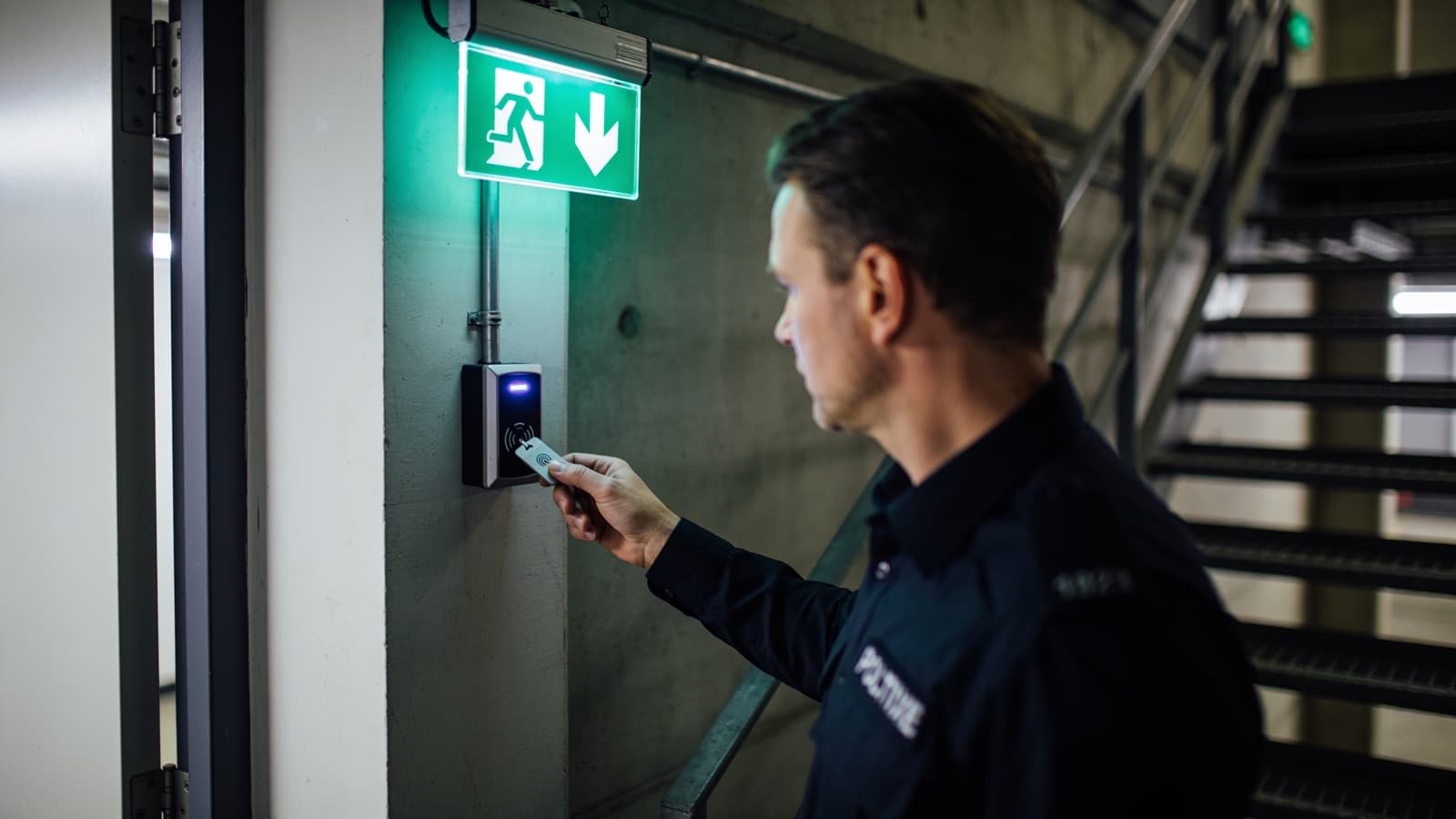
The patrol round is the core service in property and site security: a guard walks a defined route, checks fixed checkpoints and documents findings. This article explains how patrol rounds work, what belongs in the log and how to keep verifiable records – on paper or digitally.
What is a patrol round?
A patrol round is a planned tour through a building or site during which a guard checks defined points: doors and windows, utility rooms, escape routes, outdoor areas or high-risk zones. The goal is to detect break-ins, damage, fire loads and hazards early – and to be able to prove the inspection to the client.
Patrol rounds are typical for security services, corporate security and caretaker services. The terms patrol round and guard tour are used interchangeably.
How a patrol round works
In practice, patrol rounds follow a fixed pattern:
- Define route and checkpoints: The site manager defines which points are checked, in which order and at which frequency.
- Carry out the round: The guard walks the route and checks every point – locks, lighting, technical systems, suspicious persons or damage.
- Document findings: Incidents and defects are recorded with time, location and ideally a photo.
- Hand over the record: The log goes to the site manager or client – traditionally as a guard book entry, digitally as an automatic PDF report.
The number of rounds per shift is defined in the security contract. Fixed intervals are common, sometimes with deliberately varied routes so that patterns cannot be predicted from outside.
The patrol log
Without documentation, a patrol round is worthless in a dispute. A complete log contains:
- date, start and end time
- the guard's name
- site and route
- checkpoints visited with arrival times
- findings: defects, incidents, anything unusual – ideally with photos
- signature or digital user attribution
For paper documentation we provide two free templates: the site inspection log for structured property checks and the guard book template for continuous shift documentation in security services.
Paper, hardware or app: how patrol rounds are verified
Paper logs are quick to introduce but easy to manipulate and tedious to evaluate. There is no way to prove that a point was really checked at the stated time.
Classic guard tour systems with data-collector hardware produce tamper-proof scan records, but require purchase and maintenance – and only document arrival at a point, without photos or incident reports.
Patrol rounds via app combine both: the guard scans an NFC tag or QR code at each checkpoint using a smartphone. Timestamp, sequence and position are logged automatically, and findings go straight into the report with photos. The client receives audit-proof PDF reports, and the site manager sees live whether all rounds are running. This is exactly what the LiteLog patrol app is built for – the guard tour system without special hardware page shows how it replaces a complete hardware system. For a detailed comparison of app and hardware systems, see our article on the guard tour system app.
Conclusion
Patrol rounds are only as good as their records. Start with a clean log template – and switch to digital recording as soon as multiple sites, shifts or client reports come into play. LiteLog can be tested free for 14 days, no special hardware required.